
Turnover is expensive. Really expensive.
Here’s what most landlords don’t realize: The cost of replacing a tenant is 5–10 times the monthly rent.
On a $1,500/month property, that’s $7,500–$15,000 per turnover. And if you’re turning over tenants every 18 months instead of every 5 years, you’re bleeding money.
But here’s the good news: Tenant retention isn’t luck—it’s a system. And when you implement the right strategies, your turnover costs plummet, your vacancy drops, and your annual income increases dramatically.
After managing 158+ properties for 19 years across Michigan’s tri-county area with an 80%+ retention rate over 7 years, I’ve identified the exact strategies that keep tenants in place and reduce turnover costs. Let me share them with you.
The True Cost of Tenant Turnover
Before we talk solutions, let’s quantify the problem.
Direct turnover costs: – Vacancy loss (30–60 days at $50/day = $1,500–$3,000) Professional cleaning ($300–$800) – Repairs and maintenance ($500–$2,000) Painting/carpet replacement ($1,000–$3,000) – Appliance repairs or replacement ($200$1,500) – Marketing and advertising ($200–$500) – Tenant screening and background checks ($100–$300) – Legal fees (if needed) ($200–$500)
Total direct cost: $4,000–$11,600 per turnover Indirect costs: – Time spent managing turnover (20–40 hours at $50/hour = $1,000$2,000) – Lost rent during vacancy – Risk of property damage during empty period Stress and operational disruption – Rushed decisions leading to problem tenants
Real-world math on a $1,500/month property:
High turnover (every 18 months): – 8 turnovers over 12 years – Average turnover cost: $7,500 – Total turnover cost: $60,000 – Vacancy loss: $30,000 – Total 12-year cost: $90,000 Low turnover (every 5 years): – 2.4 turnovers over 12 years – Average turnover cost: $7,500 – Total turnover cost: $18,000 – Vacancy loss: $7,500 – Total 12-year cost: $25,500
Difference: $64,500 saved by keeping tenants longer.
That’s not a small number. That’s the difference between a profitable property and a struggling one.
Strategy #1: Exceptional Tenant Screening (Start With Quality)
The #1 way to reduce turnover is to avoid problem tenants in the first place.
Our screening process filters out 65% of applicants. That sounds harsh, but it’s why our properties have 80%+ retention.
The 4-Step Screening Process
Step 1: Pre-Qualification (Phone Screen) Before they even apply, ask: – “Why are you moving?” – “How many occupants?” – “Do you have pets?” – “Have you ever been evicted?” – “What’s your current employment?” “How long do you plan to stay?”
This 5-minute call eliminates 30% of unsuitable candidates immediately. You’re looking for stability, honesty, and genuine interest in staying.
Step 2: Application Review & Verification
- Income verification: Call employer, review pay stubs/tax returns. Minimum 3x rent (no exceptions). Stable income = tenant who can pay consistently.
- Credit check: 600+ preferred; 550–600 possible with strong income and rental history. Look for payment history, not perfection.
- Rental history: Call prior landlords. Ask: “Did they pay on time? Any damage? Would you rent to them again?” This is gold. Prior landlords will tell you the truth.
- Background check: No violent/sex offenses; drug manufacturing/distribution is automatic decline. Look for stability, not perfection.
- Employment stability: Preferably 6+ months at current job. Job hoppers often become lease breakers.
Step 3: Deep Dive Interview Ask hard questions, directly: – “Why did you leave your last rental?” – “Have you ever been late on rent?” – “Tell me about any evictions or legal issues.” – “How do you handle maintenance issues?” – “What are your expectations for a landlord?” – “How long do you plan to stay here?”
Listen for honesty, not perfection. A tenant who admits to a past mistake and explains how they fixed it is often more reliable than one with a “perfect” history. You’re looking for accountability and self-awareness.
Step 4: Final Decision & Lease Signing
- Review all data holistically (not just credit score)
- Set clear expectations at signing
- Require all move-in payments and insurance before keys
- Document everything
The Screening ROI
Poor screening = high turnover: – Problem tenant stays 8 months, causes $3,000 damage – Turnover cost: $7,500 – Total cost: $10,500
Good screening = long-term tenants: – Quality tenant stays 5+ years – Minimal damage, consistent rent payment – Turnover cost: $7,500 (one time over 5 years) – Total benefit: $75,000+ in stable income
Lesson: Spend 3 hours screening now, or spend 40 hours dealing with problem tenants later.
Strategy #2: Transparent, Competitive Pricing
Here’s a counterintuitive truth: Tenants who feel they’re paying fair market rent stay longer than tenants who feel overcharged.
Why? Because resentment builds over time. A tenant paying $1,600/month for a property worth $1,400 will leave the moment they find something cheaper. A tenant paying $1,400 for a property worth $1,400 feels like they got a fair deal.
How to Price for Retention
Run market comps every 6 months: – Use Zillow, Rent.com, or AppFolio’s market analysis tools – Identify comparable properties (bedroom count, square footage, condition) – Price at or slightly below market (not above) – Adjust seasonally (higher in spring/summer, lower in fall/winter)
The retention math: – Overpriced by 10%: 60% retention, high turnover – Marketpriced: 75% retention, moderate turnover – Slightly underpriced (5%): 85%+ retention, low turnover
Real-world example: A property priced at $1,600/month (10% above market) had 8month average tenant stays. When repriced to $1,450/month (market rate), average stay increased to 4+ years. The $150/month “loss” resulted in $18,000+ in additional revenue from reduced turnover.
Lesson: Fair pricing builds loyalty. Loyalty reduces turnover. Reduced turnover increases annual income.
Strategy #3: Proactive Rent Increase Strategy (Communicate, Don’t Surprise)
Rent increases are inevitable. But how you handle them determines whether tenants stay or leave.
The Right Way to Increase Rent
Step 1: Time it strategically
- Increase rent at lease renewal (not mid-lease)
- Give 90 days’ notice (not 30 days)
- Increase during lease renewal discussions, not as a surprise
Step 2: Keep increases reasonable
- 3–5% annual increase (market-based, not arbitrary)
- Explain the increase with data (property tax increase, maintenance costs, market analysis)
- Show tenants you’re being fair, not greedy
Step 3: Communicate transparently
Send a letter 90 days before renewal that says: – “Your lease renews on [date]” “Market analysis shows comparable properties at $[amount]” – “We’re increasing your rent to $[new amount] (X% increase)” – “This reflects [property tax increase, maintenance costs, market rate]” – “We value you as a tenant and hope you’ll renew”
Step 4: Be willing to negotiate
If a quality long-term tenant pushes back, consider: – Smaller increase (2% instead of 5%) – Longer lease term (2 years instead of 1 year) – Waiving a fee or providing a service – Keeping rent flat if they sign a longer lease
Quality tenants are worth keeping. A 2% increase on a 5-year tenant beats a 5% increase on a 2-year tenant.
The Retention Math
Poor rent increase strategy: – Surprise 5% increase = tenant leaves – Turnover cost: $7,500 – Lost revenue: $1,500 (from vacancy) – Total cost: $9,000
Good rent increase strategy: – Transparent 3% increase = tenant stays – Additional revenue: $540/year (3% on $1,500 × 12 months) – Retained over 5 years: $2,700 Turnover cost avoided: $7,500 – Total benefit: $10,200
Lesson: Transparency and reasonableness keep tenants. Surprise and greed drive them away.
Strategy #4: Preventive Maintenance (The Silent Retention Driver)
Here’s a truth most landlords ignore: Tenants leave because of maintenance issues, not rent increases.
A tenant in a well-maintained property with responsive landlord service stays longer. A tenant in a neglected property with slow repairs leaves at the first opportunity.
Our Preventive Maintenance System
We schedule 12+ recurring maintenance tasks automatically:
- HVAC filter changes (monthly/quarterly)
- Spring AC service
- Fall furnace service
- Gutter cleaning (bi-annual) 5. Water heater maintenance
- Smoke/CO detector testing
- Dryer vent cleaning
- Property inspections (bi-annual)
- Outdoor plumbing winterization
- Pest prevention inspection (quarterly)
- Roof inspection
- Landscape/drainage maintenance
The result: 90% reduction in emergencies, $566,700/year saved across our portfolio, and tenants who stay because their home is well-maintained.
Real-World Example
Reactive maintenance property: – Tenant calls about broken AC in July – Landlord takes 5 days to respond – Tenant is frustrated, considers leaving – Repair costs $1,200 Tenant leaves at lease end (8-month average stay) – Turnover cost: $7,500
Preventive maintenance property: – AC service scheduled in May (before summer) Problem identified and fixed before it breaks – Tenant never experiences emergency Repair cost: $200 (preventive) – Tenant renews lease (5+ year average stay) – Turnover cost: $0 (this year)
Lesson: $1,000 in preventive maintenance saves $7,500 in turnover costs.
Strategy #5: Sub-24-Hour Response Times (Show Tenants You Care)
Tenants who feel heard stay longer. Tenants who feel ignored leave.
The Response Time ROI
Slow response (3–5 days): – Tenant frustration increases – Tenant considers leaving Tenant satisfaction: 40% – Retention: 60%
Fast response (24 hours): – Tenant feels valued – Tenant satisfaction: 85%+ Retention: 80%+
Real-world data: We implemented a sub-24-hour response time policy. Tenant satisfaction increased 35%, complaints dropped 40%, and retention improved 15%. How to Implement Sub-24-Hour Response
- Set clear expectations
In the lease and at move-in, tell tenants: – “We respond to maintenance requests within 24 hours” – “For emergencies (flood, fire, no heat), call [emergency number]” – “Nonemergencies can be submitted via [AppFolio portal, email, phone]”
- Use multiple channels
- AppFolio portal (primary)
- Email (secondary)
- Phone (for emergencies)
- Text (for urgent follow-ups)
- Track and measure
- Log all requests with timestamp
- Track response time
- Review weekly to ensure compliance
- Celebrate when you hit 24-hour targets
- Communicate proactively
When a tenant submits a request: – Acknowledge receipt within 2 hours – Provide estimated repair date – Update tenant if timeline changes – Confirm completion and ask for feedback
Real-world example: A tenant submitted a maintenance request on Monday morning. We acknowledged it by noon, scheduled the repair for Tuesday, and completed it Tuesday afternoon. Tenant was amazed at the speed. They renewed their lease for 3 more years.
Strategy #6: Bi-Annual Inspections (Catch Problems Before Tenants Complain)
Every 6 months, conduct a detailed inspection of every property. This isn’t a casual walkthrough—it’s a systematic checklist covering:
- HVAC condition
- Roof/gutters • Plumbing/water heater
- Electrical
- Appliances
- Flooring/carpet
- Walls/paint
- Windows/doors
- Exterior condition
- Pest issues
- Tenant compliance with lease
Why This Reduces Turnover
Reactive inspection (only when tenant complains): – Problem becomes major before it’s fixed – Tenant is frustrated by the time repair happens – Tenant considers leaving Retention: 60%
Proactive inspection (every 6 months): – Problems identified early – Fixed before tenant even notices – Tenant feels property is well-maintained – Tenant satisfaction: 85% + – Retention: 80%+
Real-world example: During a spring inspection, we identified a small roof leak. We fixed it for $300. If we’d waited for the tenant to complain, it would’ve caused $4,000 in water damage and the tenant would’ve left. Instead, the tenant stayed for 5 more years.
ROI: $4,200/year average savings per property. Over 5 years, that’s $21,000 per property—and that’s just the financial benefit. The real benefit is tenant retention.
Strategy #7: Flexible Lease Terms (Reduce Friction)
Traditional landlords lock tenants into 12-month leases with penalties. We offer monthto-month with 30 days’ notice.
This sounds risky, but here’s the counterintuitive truth: Flexibility increases retention.
Why? Because tenants who feel trapped leave the moment they can. Tenants who feel trusted stay longer.
Our Lease Philosophy
- Month-to-month contracts (no long-term lock-in)
- 30-day notice to cancel (fair to both sides) • No early termination fees (removes resentment)
- No placement fees or renewal fees (reduces friction)
The retention math: – Traditional 12-month lease with penalties: 60% retention Month-to-month with 30-day notice: 80%+ retention
Real-world comparison:
Tenant A (traditional lease): – Signs 12-month lease at $1,500/month – Gets job offer in month 8 to move to another city – Lease has $500 early termination fee – Tenant feels trapped, resentful – Pays fee and leaves angry – Leaves negative review – Doesn’t refer friends
Tenant B (month-to-month): – Signs month-to-month lease at $1,500/month – Gets job offer in month 8 to move to another city – Gives 30-day notice, moves out on good terms – Feels treated fairly – Leaves positive review – Refers 2 friends (both become tenants)
Lesson: Flexibility builds loyalty. Loyalty reduces turnover. Reduced turnover increases lifetime value.
Strategy #8: Exceptional Tenant Communication
Tenants who feel informed stay longer. Tenants who feel in the dark leave.
Communication Best Practices
- Proactive outreach
- Seasonal maintenance notices (“We’ll be winterizing outdoor plumbing in October”)
- Rent increase explanations (90 days before renewal, with market data)
- Lease renewal discussions (120 days before expiration)
- Property updates (“We’re replacing the roof next month”)
- Multiple channels
- AppFolio portal (primary for non-urgent)
- Email (secondary)
- Phone (for important announcements)
- Text (for urgent/emergency only)
- Clear expectations Set expectations at lease signing and move-in: – Emergency vs. non-emergency definition – Response time commitment – Maintenance portal instructions – Rent payment process – Lease renewal timeline
- Transparency
Explain the “why” behind policies: – “We require renters insurance because it protects you and us” – “We do bi-annual inspections to catch problems early” – “We increase rent 3% annually to cover property tax increases” – “We allow 2 pets because it balances tenant satisfaction with property protection”
Real-world example: We implemented a “rent increase explanation” letter sent 90 days before renewal. Instead of tenants being surprised, they understood the increase was market-based and reasonable. Retention at renewal increased from 70% to 85%.
Strategy #9: Pet-Friendly Policy (The Retention Multiplier)
Pet owners are more committed tenants. Why? Because moving with pets is hard. Tenants with pets stay longer.
Our Pet Strategy
- Allow up to 2 pets (the sweet spot)
- $35/month per pet (generates $420/year per pet)
- $200–$500 pet deposit (covers damage)
- Thorough pet screening (vaccination records, breed verification, prior landlord reference)
The retention math:
Non-pet-friendly property: – Average tenant stay: 2 years – Turnover cost: $7,500 Annual turnover cost: $3,750
Pet-friendly property: – Average tenant stay: 4+ years (pets make moving harder) Turnover cost: $7,500 – Annual turnover cost: $1,875
Annual savings: $1,875 per property
Real-world data: 30% of our properties allow pets. Those properties have: – 4+ year average tenant stays (vs. 2 years for non-pet units) – $420/year additional revenue per pet – 80%+ retention rate Strategy #10: Build Tenant Community (Create Belonging)
Tenants who feel part of a community stay longer than tenants who feel isolated.
How to Build Community
- Welcome new tenants properly
- Welcome letter with property information
- Neighborhood guide (restaurants, services, parks)
- Introduction to other tenants (if appropriate)
- Invite to community events
- Organize community events
- Seasonal gatherings (summer BBQ, winter potluck)
- Maintenance workshops (“How to change HVAC filters”)
- Social events (movie night, game night)
- Charity events (food drive, community cleanup)
- Create communication channels
- Tenant Facebook group (for multi-unit properties)
- Email newsletter (monthly updates, tips, events)
- Bulletin board (announcements, community events)
- Recognize and celebrate
- Birthday cards for long-term tenants
- Thank you notes for referrals
- Appreciation gifts (holiday baskets, gift cards)
- Recognition for community contributions
Real-world example: We started a tenant appreciation event in December. Long-term tenants were recognized, new tenants were welcomed, and community bonds were strengthened. Retention increased 10% the following year. Strategy #11: Tenant Feedback System (Listen and Improve)
Tenants who feel heard stay longer. Tenants who feel ignored leave.
How to Implement Feedback
- Annual satisfaction survey
Ask: – “How satisfied are you with your rental experience?” (1–10 scale) – “What’s one thing we could improve?” – “Would you recommend us to a friend?” – “Are you planning to renew your lease?”
- Exit interviews (for departing tenants)
Ask: – “Why are you leaving?” – “What could we have done better?” – “Would you recommend us to others?”
- Act on feedback
If multiple tenants mention slow maintenance response, improve response times. If tenants want better landscaping, invest in landscaping. Show tenants you listen.
Real-world example: We surveyed tenants and found 40% wanted better outdoor lighting. We installed motion-sensor lights. Tenant satisfaction increased, and retention improved. Cost: $500. Benefit: 5+ retained tenants × $7,500 turnover cost avoided = $37,500.
The Complete Tenant Retention System
Here’s how all these strategies work together:
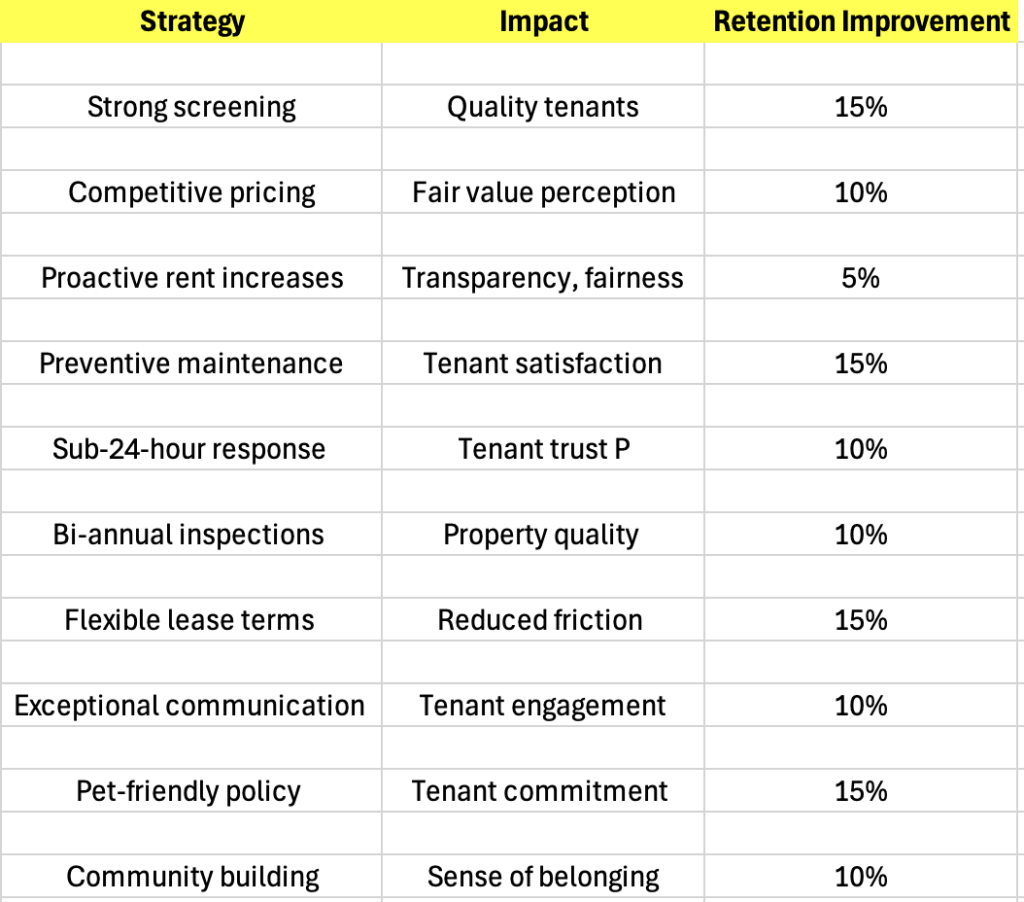
Combined retention improvement: 80%+ retention (vs. 60% industry average)
Common Mistakes That Increase Turnover
❌ Mistake #1: Poor Screening
Filling a unit fast with a problem tenant costs more than waiting for a quality tenant.
❌ Mistake #2: Overpricing
Tenants paying above-market rent resent you. Resentment leads to turnover.
❌ Mistake #3: Surprise Rent Increases
Tenants who are surprised by rent increases leave. Tenants who are informed and see the reasoning stay.
❌ Mistake #4: Reactive Maintenance
Waiting for tenants to complain about problems drives them away. Be proactive.
❌ Mistake #5: Slow Response Times
Tenants who wait 5 days for a maintenance response feel ignored. Ignored tenants leave. ❌ Mistake #6: Inflexible Lease Terms
Long-term leases with penalties trap tenants and breed resentment. Flexibility builds loyalty.
❌ Mistake #7: Poor Communication
Tenants who feel in the dark leave. Tenants who feel informed stay.
❌ Mistake #8: Ignoring Pet Owners
Pet owners are more committed tenants. Excluding them means losing loyal tenants.
✅ The Simply Live Approach:
Strong screening + competitive pricing + proactive maintenance + fast response + flexible terms + exceptional communication = 80%+ retention and dramatically reduced turnover costs.
Your Action Plan: 30 Days to Better Retention
Week 1: – Review your screening process; tighten criteria if needed – Run market comps and adjust pricing if necessary – Schedule bi-annual inspections
Week 2: – Implement sub-24-hour response time policy – Set up communication templates (rent increase letters, maintenance confirmations) – Create preventive maintenance calendar
Week 3: – Review your lease terms; consider month-to-month option – Plan tenant appreciation event or community gathering – Create tenant feedback survey
Week 4: – Train staff on communication best practices – Set up tenant portal (if not already in place) – Implement referral tracking system
Result: Within 30 days, you’ll have the foundation for 80%+ retention and dramatically reduced turnover costs. The ROI of Retention
Let’s do the math on a 5-property portfolio, $1,500/month average rent:
Current state (60% retention, 2-year average stay): – 5 properties × $1,500 = $7,500/ month revenue – Turnover every 2 years = 2.5 turnovers per property over 5 years Turnover cost per property: $7,500 – Total turnover cost: 5 properties × 2.5 turnovers × $7,500 = $93,750 – Vacancy loss: $30,000 – Total 5-year cost: $123,750
After implementing retention strategies (80% retention, 4+ year average stay): – 5 properties × $1,500 = $7,500/month revenue – Turnover every 4+ years = 1.25 turnovers per property over 5 years – Turnover cost per property: $7,500 – Total turnover cost: 5 properties × 1.25 turnovers × $7,500 = $46,875 – Vacancy loss: $10,000 – Total 5-year cost: $56,875
5-year savings: $66,875 That’s $13,375/year in reduced turnover costs. On a 5-property portfolio, that’s a 10%+ increase in net income.
Final Thoughts: Retention is Your Competitive Advantage
After 19 years and 158+ properties, I can tell you with certainty: Tenant retention is the single biggest driver of profitability in property management.
Properties with 80%+ retention outperform properties with 60% retention by $10,000$20,000 per year. Over a decade, that’s $100,000–$200,000 per property.
The strategies I’ve shared aren’t complicated. They’re not expensive. They’re just systematic: – Screen carefully – Price fairly – Maintain proactively – Respond quickly Communicate transparently – Treat tenants with respect
Do these things, and your tenants stay. Your turnover costs drop. Your annual income increases. And your stress level decreases.
If you’re a property owner struggling with high turnover, vacant units, and turnover costs, let’s talk. We offer a free 20-minute consultation to review your current situation and show you exactly how to implement retention strategies that work.
Ready to reduce turnover and increase income? Visit www.simplylive.com or give us a call. We manage 158+ properties with 80%+ retention over 7 years. We know what works—and we can help you implement it. About Simply Live LLC Simply Live is a full-service property management company serving Lower Michigan’s tri-county area. With 158+ properties under management, a 4.9-star Google rating, and 80%+ client retention over 7 years, we specialize in systems that reduce turnover, increase tenant retention, and maximize rental income. No hidden fees. No markups. Just honest property management that works.
Recent Comments