
Here’s a question I get asked constantly: “Should I hire in-house maintenance staff or outsource to contractors?”
Most property managers get this wrong. They either: – Outsource everything and lose control of quality, costs, and timelines – Hire in-house staff and get buried in payroll, benefits, and management headaches – Do a mix without clear criteria, creating chaos and inefficiency
After 19 years managing 158+ properties with a team of in-house professionals, I can tell you the answer isn’t “one or the other.” It’s knowing which tasks to handle in-house and which to outsource.
This blog post gives you the exact framework we use at Simply Live to decide. Follow it, and you’ll cut costs, improve quality, and scale without losing control.
The Real Cost of Getting This Wrong
Before we dive into the framework, let’s talk about what happens when you make the wrong choice.
The Outsource-Everything Trap
Scenario: You outsource all maintenance to contractors.
What happens: – Quality varies wildly: Different contractors have different standards. Some do excellent work. Others cut corners. – Costs spiral: Contractors mark up labor 50–100%. A $50 repair becomes $75–$100. – Slow response times: Contractors prioritize their own work. Your tenants wait days for a response. – Tenant complaints: Inconsistent service leads to bad reviews and tenant turnover. – You lose control: You’re dependent on contractors. If they’re busy, your tenants suffer. – Hidden fees: Markup on parts, travel fees, service call minimums—costs add up fast.
Real-world example: A property owner outsources all maintenance to a local contractor. Average response time: 3–5 days. Tenant satisfaction: 2.8 stars. Annual maintenance cost: $8,400 per property. Tenant turnover: 45% per year.
Result: High vacancy, high turnover, low reputation, high costs. The Hire-Everyone Trap
Scenario: You hire in-house staff for everything.
What happens: – Payroll bloat: You’re paying staff even when there’s no work (winter, slow seasons). – Benefits and taxes: Payroll taxes, workers’ comp, health insurance, retirement—costs add up to 30–40% of salary. – Management overhead: You’re managing staff, handling conflicts, dealing with turnover. – Specialized work: You hire a general handyman, but they can’t handle electrical, plumbing, or HVAC. So you hire more staff. – Inefficiency: Staff are underutilized in slow seasons, overwhelmed in peak seasons. – Skill gaps: You end up with staff who aren’t qualified for specialized work, so quality suffers.
Real-world example: A property manager hires 3 full-time handymen for a 50-property portfolio. Annual payroll cost (salary + benefits + taxes): $180,000. In winter, they’re 40% underutilized. In spring, they’re overwhelmed and can’t keep up. Result: Inconsistent quality, high costs, frustrated staff.
Result: High payroll costs, inconsistent quality, management headaches.
The Chaotic Mix Trap
Scenario: You do a mix of in-house and outsourced without clear criteria.
What happens: – Confusion: Nobody knows who’s responsible for what. Work falls through the cracks. – Duplicate work: In-house staff and contractors both show up to the same job. – Finger-pointing: When something goes wrong, in-house staff blame contractors and vice versa. – Quality inconsistency: In-house work is good. Contractor work is mediocre. Tenants get confused. – Cost overruns: You’re paying for both inhouse staff AND contractor markups. Costs are highest. – Scheduling nightmares: Coordinating between in-house and contractors is a logistical nightmare.
Real-world example: A property manager has 2 in-house handymen and uses contractors for “specialty work.” But nobody defines what’s specialty. Sometimes inhouse staff do the work. Sometimes contractors do. Costs are all over the place. Quality is inconsistent. Tenants are frustrated.
Result: Highest costs, lowest quality, maximum chaos. The Framework: In-House vs. Outsourced
Here’s the framework we use at Simply Live to decide what to handle in-house and what to outsource.
The Decision Matrix
For each maintenance task, ask four questions:
- Frequency: How often does this task come up? (High = weekly/monthly; Low = quarterly/annually)
- Complexity: How difficult is the task? (High = requires specialized skills; Low = basic handyman work)
- Urgency: How quickly does it need to be done? (High = emergency response needed; Low = can wait days)
- Volume: How many properties need this work? (High = 50+ properties; Low = 510 properties) Scoring: – High frequency + Low complexity + High urgency + High volume = INHOUSE – Low frequency + High complexity + Low urgency + Low volume = OUTSOURCE – Everything else = CASE-BY-CASE
What We Do In-House (95% of Maintenance)
At Simply Live, we handle 95% of maintenance in-house. Here’s what that includes:
Routine Maintenance (Weekly/Monthly)
- HVAC filter changes (monthly/quarterly)
- Smoke/CO detector testing (bi-annual)
- Gutter cleaning (bi-annual)
- Landscaping and lawn care (weekly/bi-weekly)
- Pest prevention inspections (quarterly)
- Property inspections (bi-annual)
Why in-house? High frequency, low complexity, high volume. We need fast, consistent, affordable service. Cost comparison: – In-house: $150/property/year (labor only; we do it ourselves) Outsourced: $400–$600/property/year (contractor markup) – Annual savings (50 properties): $12,500–$22,500
Common Repairs (Daily/Weekly)
- Faucet repairs (washers, cartridges, aerators)
- Toilet repairs (flapper, fill valve, wax ring)
- Door lock repairs and replacement
- Door hinge adjustment
- Light fixture replacement
- Outlet and switch replacement
- Drywall repair (small holes, patching)
- Caulking and weatherstripping
- Paint touch-ups
- Appliance troubleshooting (refrigerator, stove, dishwasher, washer/dryer)
Why in-house? High frequency, low-to-medium complexity, high urgency, high volume. Tenants expect fast response. Contractors are slow and expensive.
Cost comparison: – In-house: $50–$150 per repair (labor + parts) – Outsourced: $150–$400 per repair (contractor markup + service call fee) – Annual savings (50 properties, 52 repairs/year): $260,000–$1,300,000
Preventive Maintenance (Seasonal)
- Spring AC service (filter, coils, refrigerant check)
- Fall furnace service (filter, ignition, safety check)
- Water heater maintenance (flush, anode rod inspection)
- Dryer vent cleaning (lint removal, duct inspection)
- Roof inspection (shingles, flashing, gutters)
- Foundation and drainage inspection (cracks, water intrusion, grading)
- Outdoor plumbing winterization (shut-off valves, drain lines)
Why in-house? High volume, preventive (saves money long-term), seasonal (can schedule efficiently). Cost comparison: – In-house: $200–$400/property/year – Outsourced: $600–$1,200/ property/year – Annual savings (50 properties): $20,000–$40,000
ROI: Preventive maintenance saves $4,200/property/year in emergency repairs. That’s 900%+ ROI.
Emergency Response (24/7)
- Flood/water damage (shut off water, assess damage, dry out)
- Fire/smoke damage (assess damage, secure property)
- Electrical issues (circuit breaker trips, outlets not working)
- Heating/cooling failure (no heat in winter, no AC in summer)
- Plumbing emergencies (burst pipes, backed-up sewers)
- Security issues (broken locks, broken windows)
Why in-house? High urgency, high volume, high tenant impact. Contractors can’t respond fast enough. Tenants need immediate help.
Cost comparison: – In-house: $150 emergency fee (after-hours response) Outsourced: $300–$500 emergency fee (contractor emergency markup) – Annual savings (50 properties, 5 emergencies/year): $37,500–$87,500
What We Outsource (5% of Maintenance)
At Simply Live, we outsource only specialized work that requires licenses, permits, or expertise we don’t have in-house.
Licensed Trades (Permit-Required)
- Electrical work (panel upgrades, 240V circuits, code compliance)
- Plumbing work (main line repairs, water heater replacement, code compliance)
- HVAC work (compressor replacement, refrigerant handling, system replacement)
- Roofing (roof replacement, structural repairs, code compliance)
- Gas work (furnace replacement, gas line installation, code compliance) Why outsource? Requires state licenses and permits. Liability is high. We’re not licensed to do this work.
Cost: $200–$500/hour (licensed contractor) Volume: 2–5 jobs per property per year Annual cost (50 properties): $20,000–$125,000
Specialized Services
- Appliance replacement (refrigerator, stove, dishwasher, washer/dryer)
- Carpet and flooring replacement
- Painting (full interior/exterior, not touch-ups)
- Drywall installation (large areas, not small patches)
- Window replacement
- Door replacement
- Deck/patio installation
- Siding replacement
Why outsource? Requires specialized equipment, expertise, or time investment that’s not efficient in-house.
Cost: $500–$5,000 per job (varies by scope) Volume: 1–3 jobs per property per year Annual cost (50 properties): $25,000–$750,000 (depends on scope)
One-Off Services
- Pest control (quarterly/annual treatment)
- Chimney cleaning and inspection
- Septic system pumping
- Well water testing
- Asbestos/lead testing
- Mold remediation
Why outsource? Specialized equipment, certifications, or infrequent need. Not cost-effective to do in-house.
Cost: $200–$1,000 per service Volume: 0–2 services per property per year Annual cost (50 properties): $5,000–$100,000
The Economics: In-House vs. Outsourced
Let’s look at the real numbers.
Scenario: 50-Property Portfolio
In-House Model (Simply Live Approach)
- Staff: 2 full-time handymen, 1 part-time supervisor
- Annual payroll (salary + benefits + taxes): $120,000
- Equipment and tools: $5,000/year
- Training and development: $3,000/year
- Vehicle and mileage: $8,000/year
- Total annual cost: $136,000
- Cost per property: $2,720/year
- Cost per work order (52 orders/property/year): $52/order
Outsource Model (All Contractors)
- Average maintenance cost per property: $6,000–$8,000/year
- Contractor markup: 50–100%
- Cost per property: $6,000–$8,000/year
- Cost per work order (52 orders/property/year): $115–$154/order
Comparison:
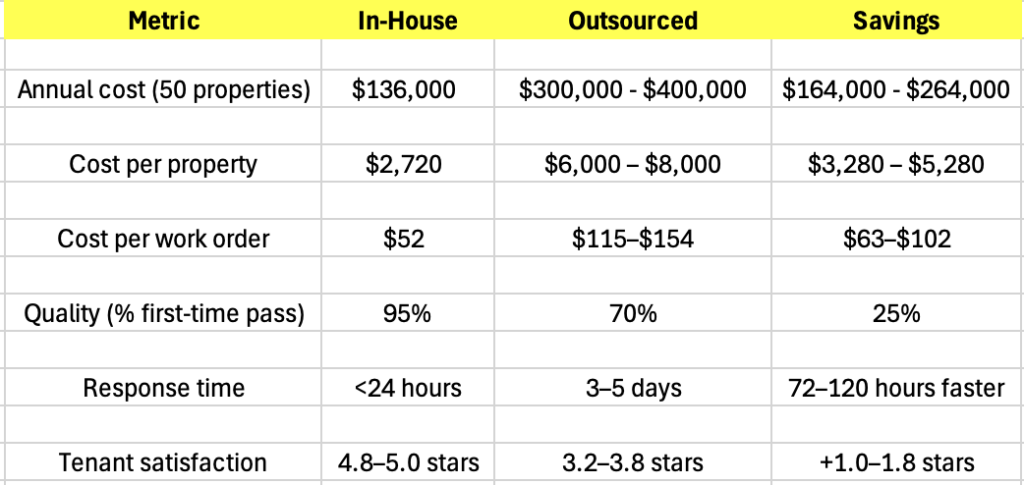
Annual savings (50 properties): $164,000–$264,000 5-year savings: $820,000–$1,320,000
Scenario: 10-Property Portfolio (Smaller Operation)
For smaller operations, the math is different.
In-House Model
- Staff: 1 part-time handyman (20 hours/week)
- Annual payroll: $25,000
- Equipment and tools: $2,000/year
- Vehicle and mileage: $3,000/year
- Total annual cost: $30,000
- Cost per property: $3,000/year
Outsource Model
- Average maintenance cost per property: $6,000–$8,000/year
- Cost per property: $6,000–$8,000/year
Comparison:

Annual savings (10 properties): $30,000–$50,000 5-year savings: $150,000–$250,000
When to Transition from Outsourced to In-House
If you’re currently outsourcing all maintenance, when should you hire in-house staff?
The Break-Even Point:
- At 20–30 properties: Hire your first part-time handyman
- At 40–50 properties: Hire your first full-time handyman
- At 75–100 properties: Hire a second full-time handyman + supervisor
- At 150+ properties: Hire a team of 3–4 handymen + supervisor + coordinator
Why these numbers? At 20 properties, you have enough volume to keep one part-time person busy. At 40 properties, you have enough volume for a full-time person. And so on.
Before you hire:
- Document your current maintenance costs for 3–6 months
- Calculate your break-even point (annual payroll ÷ cost per property outsourced)
- Verify you have enough volume to keep staff busy
- Hire a mentor or experienced handyman to train new staff
- Implement your 30-day training program (see our blog post on this)
- Track quality and costs for 6 months to verify ROI
The Hybrid Model: Best of Both Worlds
Most successful property managers use a hybrid model:
- In-house: 90–95% of maintenance (routine, common repairs, preventive, emergency) • Outsourced: 5–10% of maintenance (licensed trades, specialized services, one-offs)
Why this works: – Cost control: You control the majority of costs through in-house staff – Quality control: You control quality through training and systems – Flexibility: You can scale up/down based on volume – Specialization: You outsource work that requires licenses or expertise – Efficiency: You focus on what you do best and outsource the rest
Implementation:
- Hire 1–2 in-house handymen for routine and common repairs
- Build relationships with 3–5 trusted contractors for specialized work
- Create clear criteria for what’s in-house vs. outsourced
- Document everything in AppFolio or your property management system
- Track costs and quality to verify ROI
- Adjust as needed based on volume and performance
How to Choose Contractors (For Outsourced Work)
When you do outsource, choose contractors carefully. Bad contractors will destroy your reputation.
Contractor Selection Criteria
- Insurance: Minimum $1 million general liability policy (verified)
- Licensing: State license for their trade (verified with state)
- References: 3+ recent client references (called and verified)
- Pricing: Competitive but not the cheapest (cheap = low quality)
- Responsiveness: Returns calls within 24 hours
- Professionalism: Shows up on time, dressed professionally, courteous
- Documentation: Provides written estimates and invoices
- Warranty: Offers warranty on work performed
Contractor Agreement
- Scope of work: Clearly defined, in writing
- Pricing: Fixed price or hourly rate (agreed upfront)
- Timeline: Start and completion dates
- Quality standards: What “done right” looks like • Insurance: Proof of current insurance
- Payment terms: When and how you’ll pay
- Warranty: How long the work is guaranteed
- Cleanup: Contractor responsible for cleanup
- Communication: How to contact and report issues
Ongoing Management
- Get 2–3 quotes for major work (over $500)
- Price shop every 2 years for recurring services (pest control, landscaping, etc.)
- Track performance (quality, timeliness, professionalism)
- Get tenant feedback on contractor work
- Replace underperformers quickly
- Build relationships with your top 3–5 contractors
Red Flags: When to Fire a Contractor
- Poor quality work: Rework needed, tenant complaints
- Slow response: Takes days to return calls or show up
- Unprofessional: Shows up late, dressed unprofessionally, rude to tenants
- Hidden fees: Charges for things not agreed upfront
- No documentation: Doesn’t provide invoices or receipts
- Insurance issues: Can’t provide proof of current insurance
- Tenant complaints: Tenants report bad experience
- Missed deadlines: Doesn’t complete work on time
Action: Give one warning. If they don’t improve, replace them.
The Scaling Strategy: From Outsourced to In-House to Scaled
Here’s the typical path we see successful property managers take:
Stage 1: Startup (1–20 Properties)
- Model: Outsource all maintenance
- Staffing: None
- Cost: $6,000–$8,000/property/year
- Quality: Inconsistent • Response time: 3–5 days
- Tenant satisfaction: 3.2–3.8 stars
Action: Document costs, identify patterns, prepare to hire.
Stage 2: Growth (20–50 Properties)
- Model: Hire 1 part-time handyman, outsource specialty work
- Staffing: 1 part-time handyman (20 hours/week)
- Cost: $3,000–$4,000/property/year
- Quality: 90%+ first-time pass
- Response time: <24 hours
- Tenant satisfaction: 4.5–4.8 stars
Action: Track performance, build processes, prepare to hire full-time.
Stage 3: Scale (50–150 Properties)
- Model: Hire 2–3 full-time handymen, outsource specialty work
- Staffing: 2–3 full-time handymen, 1 supervisor
- Cost: $2,500–$3,500/property/year
- Quality: 95%+ first-time pass
- Response time: <24 hours
- Tenant satisfaction: 4.8–5.0 stars
Action: Implement systems, train staff, optimize processes.
Stage 4: Maturity (150+ Properties)
- Model: Hire 4+ full-time handymen, 1 supervisor, 1 coordinator, outsource specialty work
- Staffing: 4–5 full-time handymen, 1 supervisor, 1 coordinator
- Cost: $2,000–$2,500/property/year
- Quality: 95%+ first-time pass
- Response time: <24 hours
- Tenant satisfaction: 4.8–5.0 stars Action: Delegate management, focus on strategy, optimize for profitability.
Implementation Checklist: Transitioning to In-House
If you’re ready to transition from outsourced to in-house, use this checklist:
Phase 1: Preparation (Weeks 1–4)
- Document current maintenance costs for 3–6 months
- Calculate break-even point (when in-house becomes cheaper)
- Verify you have enough volume to keep staff busy
- Create job description for handyman position Identify 3–5 candidates
- Develop hiring criteria (integrity, willingness to learn, reliability)
- Create interview questions
Phase 2: Hiring (Weeks 5–6)
- Interview candidates
- Check references
- Verify background
- Make job offer
- Negotiate salary and benefits
- Prepare onboarding materials
Phase 3: Onboarding (Weeks 7–8)
- Welcome new hire
- Complete orientation
- Assign mentor (experienced contractor or supervisor)
- Begin 30-day training program
- Provide tools and equipment
Phase 4: Training (Weeks 9–14)
- Complete 30-day training program
- Conduct 30-day performance review
- Make pass/fail decision If pass: Integrate into team If fail:
- Replace and restart
Phase 5: Optimization (Weeks 15+)
- Track quality and costs
- Gather tenant feedback
- Make adjustments as needed
- Plan next hire (if volume supports it)
- Build systems and processes
Common Mistakes to Avoid
Mistake #1: Hiring Too Early
Problem: You hire in-house staff before you have enough volume to keep them busy. Result: Staff are underutilized, payroll costs are high, ROI is negative.
Solution: Wait until you have 20+ properties and can keep staff busy at least 80% of the time.
Mistake #2: Hiring the Wrong Person
Problem: You hire someone without integrity or willingness to learn.
Result: Poor work quality, tenant complaints, high turnover, wasted training investment.
Solution: Hire for integrity and willingness to learn. Use the hiring criteria and interview questions in our 30-day training program blog post.
Mistake #3: Skipping Training
Problem: You hire someone and throw them into the field without proper training. Result: Poor work quality, tenant complaints, mistakes, low confidence.
Solution: Implement a structured 30-day training program. See our blog post for details.
Mistake #4: Not Tracking Costs
Problem: You don’t track maintenance costs before and after hiring in-house staff. Result: You don’t know if you’re actually saving money. You can’t justify the investment. Solution: Track costs for 3–6 months before hiring. Track costs for 6 months after hiring. Compare and verify ROI.
Mistake #5: Outsourcing Everything
Problem: You outsource all maintenance and never transition to in-house.
Result: High costs, low quality, slow response times, low tenant satisfaction, low profitability.
Solution: Use the break-even analysis to determine when to hire in-house staff. Don’t leave money on the table.
Final Thoughts: The Right Model for Your Business
After 19 years and 158+ properties, here’s what I know: The hybrid model works best.
- In-house: Routine, common repairs, preventive maintenance, emergency response (90–95% of work)
- Outsourced: Licensed trades, specialized services, one-offs (5–10% of work) This model gives you: – Cost control: In-house staff are cheaper than contractor markups – Quality control: You control training and standards – Speed: Fast response times, <24-hour turnaround – Flexibility: Scale up/down based on volume Specialization: Outsource work that requires licenses or expertise – Reputation: Excellent tenant satisfaction, 4.8–5.0 star ratings The result: Higher profitability, better tenant retention, stronger reputation, and a team you trust.
If you’re struggling with maintenance costs, quality, or response times, the answer isn’t to hire more people or outsource more work. It’s to implement the right model for your business. We’ve done it at Simply Live with 158+ properties and a team of trained professionals. We know what works—and we can help you implement it.
Ready to optimize your maintenance model? Visit www.simplylive.com or give us a call for a free 20-minute consultation. We’ll analyze your current costs, show you your break-even point, and help you transition to a model that works for your business.
About Simply Live LLC Simply Live is a full-service property management company serving Lower Michigan’s tri-county area. With 158+ properties under management, a 4.9-star Google rating, and a hybrid maintenance model (95% in-house, 5% outsourced), we deliver exceptional quality at competitive costs. Our approach—combining trained in-house staff with carefully selected contractors—has generated $820,000–$1,320,000 in savings over five years compared to full outsourcing. No shortcuts. No excuses. Just smart, profitable property management.
Recent Comments