

Vacancy is a landlord’s silent killer. Every empty day is lost rent, and every empty month is a financial hemorrhage.
Here’s the reality: the average rental property sits vacant 30–45 days per year. That’s $1,500–$2,250 in lost income on a $1,500/month property. Over 5 years, that’s $7,500–$11,250 per property—money that could’ve been in your pocket.
But at Simply Live, our properties average 15 days of vacancy per year. That’s 50% better than industry standard. And it’s not luck—it’s a system.
After managing 158+ properties for 19 years across Michigan’s tri-county area, I’ve identified the exact strategies that keep rental properties occupied year-round. Let me share them with you.
The True Cost of Vacancy
Before we dive into solutions, let’s quantify the problem.
Direct costs of vacancy: – Lost rent (obvious) – Turnover cleaning and repairs Marketing and advertising costs – Tenant screening and application fees – Utilities and maintenance on empty units – Property deterioration (empty homes age faster)
Indirect costs: – Reduced annual income (affects refinancing, equity calculations) Stress and time spent finding tenants – Rushed decisions leading to problem tenants Emergency repairs on neglected properties
The math: A $1,500/month property vacant for 45 days costs you: – Lost rent: $2,250 Cleaning/repairs: $500–$1,000 – Marketing: $200–$500 – Total: $2,950–$3,750 per vacancy cycle
Over 5 years with 2 vacancy cycles, that’s $11,800–$15,000 in losses.
Now imagine reducing that to 15 days. You just saved $7,000–$10,000 per property. That’s real money.
Strategy #1: Competitive, Strategic Pricing
The biggest mistake landlords make: Setting rent based on emotion, not data.
“I want $1,600/month because that’s what I paid for the property” doesn’t work. The market doesn’t care about your mortgage—it cares about comparable properties.
How to Price Right
Step 1: Run Comps Every 6 Months Use Zillow, Rent.com, or AppFolio’s market analysis tools to identify: – Similar properties in your area (bedroom count, square footage, condition) – Current rental rates – Days on market – Amenities that command premium pricing
Step 2: Price Aggressively (But Not Desperately)
- Slightly undercut the market (5–10% below comparable properties) = faster fills, less vacancy
- Match the market exactly = longer time to fill, more marketing spend
- Overprice by 10%+ = extended vacancy, rushed tenant decisions, higher turnover
Real-world example: We inherited a property listed at $1,400/month that sat vacant for 60 days. We repriced it at $1,250/month. It filled in 8 days. The owner saved $2,000 in vacancy costs and got a quality tenant. The $150/month “loss” was actually a $2,000 gain.
Step 3: Adjust Seasonally
- Spring/Summer: Slightly higher rates (peak moving season)
- Fall/Winter: Slightly lower rates or add incentives (move-in specials, reduced deposits)
Step 4: Factor in Tenant Quality A quality tenant at $1,400/month who stays 5 years beats a problem tenant at $1,500/ month who leaves in 8 months. Do the math:
Quality tenant (5 years): – Annual revenue: $16,800 – 5-year total: $84,000 – Vacancy: 15 days/year = $1,500 lost – 5-year net: $82,500 Problem tenant (8 months): – 8-month revenue: $12,000 – Turnover/damage costs: $3,000 – Re-marketing/vacancy: $2,500 – 8-month net: $6,500 – Then you’re back to square one
Lesson: Price to attract quality, not to maximize short-term rent.
Strategy #2: Exceptional Tenant Screening (The Real Vacancy Killer)
You can’t keep a property occupied if you fill it with problem tenants who leave early, don’t pay, or destroy the unit.
Our screening process filters out 65% of applicants. That sounds harsh, but it’s why our properties stay occupied.
The 4-Step Screening Process
Step 1: Pre-Qualification (Phone Screen) Before they even apply, ask: – “Why are you moving?” – “How many occupants?” – “Do you have pets?” – “Have you ever been evicted?” – “What’s your current employment?”
This 5-minute call eliminates 30% of unsuitable candidates immediately.
Step 2: Application Review & Verification
- Income verification: Call employer, review pay stubs/tax returns. Minimum 3x rent (no exceptions).
- Credit check: 600+ preferred; 550–600 possible with strong income and rental history.
- Rental history: Call prior landlords. Ask: “Did they pay on time? Any damage? Would you rent to them again?”
- Background check: No violent/sex offenses; drug manufacturing/distribution is automatic decline.
- Employment stability: Preferably 6+ months at current job.
Step 3: Deep Dive Interview Hard questions, asked directly: – “Why did you leave your last rental?” – “Have you ever been late on rent?” – “Tell me about any evictions or legal issues.” – “How do you handle maintenance issues?” – “What are your expectations for a landlord?” Listen for honesty, not perfection. A tenant who admits to a past mistake and explains how they fixed it is often more reliable than one with a “perfect” history.
Step 4: Final Decision & Lease Signing
- Review all data holistically (not just credit score)
- Set clear expectations at signing
- Require all move-in payments and insurance before keys
- Document everything
The Screening ROI
Poor screening = high turnover: – Problem tenant stays 8 months, causes $3,000 damage – 60 days vacancy to find replacement – Total cost: $5,500
Good screening = long-term tenants: – Quality tenant stays 5+ years – Minimal damage, consistent rent payment – 15 days vacancy between tenants – Total benefit: $50,000+ in stable income
Lesson: Spend 2 hours screening now, or spend 40 hours dealing with problem tenants later.
Strategy #3: Pet-Friendly Policy (The Occupancy Multiplier)
Here’s a stat that surprises most landlords: Pet-friendly units fill 40% faster than nonpet units.
Why? Because 67% of U.S. households own pets, and finding pet-friendly housing is their #1 challenge.
Our Pet Strategy
- Allow up to 2 pets (the sweet spot)
- $35/month per pet (generates $420/year per pet)
- $200–$500 pet deposit (covers damage)
- Thorough pet screening (vaccination records, breed verification, prior landlord reference)
The math on a pet-friendly property: – Fills 40% faster = 10 fewer vacancy days/year – Pet fee revenue = $840/year (2 pets average) – Longer tenant retention = fewer turnover cycles – Annual benefit: $1,500–$2,000 per property Real-world impact: 30% of our properties allow pets. Those properties have: – 15-day average vacancy (vs. 25 days for non-pet units) – $420/year additional revenue per pet 80%+ tenant retention
Strategy #4: Fast, Professional Turnovers
Vacancy starts the moment a tenant gives notice. How you handle that window determines how fast you fill the unit.
The Turnover Timeline
Day 1–3 (Tenant Notice): – Schedule move-out inspection – Begin marketing immediately (don’t wait for tenant to leave) – Prepare property maintenance list
Day 4–7 (Move-Out & Inspection): – Document move-out condition with photos Identify repairs needed – Begin deep cleaning
Day 8–14 (Repairs & Preparation): – Complete all repairs – Professional cleaning Final walkthrough and photos – List property online
Day 15–30 (Marketing & Showing): – Active marketing (Facebook, Zillow, Rent.com, Google) – Schedule showings – Collect applications – Screen qualified candidates
Day 31+ (Lease Signing & Move-In): – Final lease review – Collect deposits and first month’s rent – Conduct move-in inspection – Provide tenant portal access
Key Tactics for Fast Fills
- List Immediately (Don’t Wait)
Start marketing the day you know the tenant is leaving—not after they move out. This overlapping window can cut 10 days off your vacancy.
- Professional Photos & Video
A property with professional photos fills 40% faster than one with phone pictures. Invest $150–$300 in quality photos. It pays for itself in 2 days of faster occupancy.
- Highlight Unique Features
- Pet-friendly policy
- Preventive maintenance (recent HVAC service, new roof, etc.)
- Included amenities • Flexible lease terms
- Price Competitively
As discussed earlier, slight underpricing dramatically reduces vacancy time.
- Respond Fast to Inquiries
Every inquiry that goes unanswered is a lost tenant. Respond within 2 hours, not 2 days.
- Make Showings Easy
- Flexible showing times (evenings, weekends)
- Virtual tours for out-of-area applicants
- Quick application process (online, not paper)
Strategy #5: Preventive Maintenance (Keep Tenants Longer)
Here’s a truth most landlords ignore: Tenants leave because of maintenance issues, not rent increases.
A tenant in a well-maintained property with responsive landlord service stays longer. A tenant in a neglected property with slow repairs leaves at the first opportunity.
Our Preventive Maintenance System
We schedule 12+ recurring maintenance tasks automatically:
- HVAC filter changes (monthly/quarterly)
- Spring AC service
- Fall furnace service
- Gutter cleaning (bi-annual)
- Water heater maintenance
- Smoke/CO detector testing
- Dryer vent cleaning
- Property inspections (bi-annual)
- Outdoor plumbing winterization
- Pest prevention inspection (quarterly)
- Roof inspection
- Landscape/drainage maintenance The result: 90% reduction in emergencies, $566,700/year saved, and tenants who stay because their home is well-maintained.
Tenant Communication
When maintenance is done proactively: – Tenants feel valued – Emergency calls drop 90% – Tenant satisfaction increases – Retention improves dramatically
Real-world example: A property with reactive maintenance (only fixing things when tenants complain) averaged 8-month tenant stays. After switching to preventive maintenance, average stay increased to 4+ years. The difference? One system, two completely different outcomes.
Strategy #6: Bi-Annual Inspections (Catch Problems Early)
Every 6 months, conduct a detailed inspection of every property. This isn’t a casual walkthrough—it’s a systematic checklist covering:
- HVAC condition
- Roof/gutters
- Plumbing/water heater
- Electrical
- Appliances
- Flooring/carpet
- Walls/paint
- Windows/doors
- Exterior condition
- Pest issues
- Tenant compliance with lease
Why this works: – Catch small problems before they become expensive repairs Identify maintenance needs before tenants complain – Document property condition for security deposit disputes – Show tenants you care about the property – Reduce emergency calls by 80%+
ROI: $4,200/year average savings per property. Over 3 years, that’s $12,600 per property—and that’s just the financial benefit. The real benefit is tenant retention and reduced vacancy.
Strategy #7: Flexible Lease Terms (Reduce Friction)
Traditional landlords lock tenants into 12-month leases. We offer month-to-month with 30 days’ notice.
This sounds risky, but here’s the counterintuitive truth: Flexibility increases retention.
Why? Because tenants who feel trapped leave the moment they can. Tenants who feel trusted stay longer.
Our Lease Philosophy
- Month-to-month contracts (no long-term lock-in)
- 30-day notice to cancel (fair to both sides)
- No early termination fees (removes resentment)
- No placement fees or renewal fees (reduces friction)
The result: 80%+ retention over 7 years. Tenants stay because they want to, not because they’re trapped.
Real-world comparison: – Traditional 12-month lease: 60% retention, high turnover Month-to-month with 30-day notice: 80%+ retention, low turnover
The month-to-month approach generates more stable, long-term occupancy.
Strategy #8: Exceptional Tenant Communication
Tenants who feel heard stay longer. Tenants who feel ignored leave.
Communication Best Practices
- Respond to maintenance requests within 24 hours (not 3 days)
- Use multiple channels (AppFolio portal, email, phone, text for emergencies)
- Proactive outreach (seasonal maintenance notices, rent increase explanations, lease renewal discussions)
- Clear expectations (lease signing, move-in walkthrough, emergency vs. nonemergency guidelines)
- Transparency (explain why rent increases, why certain policies exist, why maintenance is needed) Real-world example: We implemented a sub-24-hour response time policy. Tenant satisfaction increased 35%, complaints dropped 40%, and retention improved 15%. The cost? Better scheduling and prioritization. The benefit? Dramatically reduced vacancy.
Strategy #9: Build a Referral Engine
70–80% of our new tenants come from referrals. Why? Because quality tenants know other quality tenants.
How to Build Referrals
- Treat Current Tenants Exceptionally
If you want referrals, earn them through excellent service.
- Ask for Referrals
At lease renewal or move-out, ask: “Do you know anyone looking for a rental? We’d love to meet them.”
- Incentivize Referrals
Some landlords offer $100–$200 referral bonuses. We don’t—our reputation does the work. But it’s an option if you’re starting out.
- Make Referrals Easy
Provide a simple way for tenants to refer friends (email, phone, online form).
- Follow Up
When a referral becomes a tenant, thank the referring tenant. This reinforces the behavior.
Result: 80%+ referral conversion rate. Referred tenants are pre-screened by current tenants and are typically higher quality.
Strategy #10: Leverage Technology (AppFolio & Beyond)
Technology doesn’t keep properties occupied—systems do. But technology enables systems. Our Tech Stack
- AppFolio: Central hub for rent collection, maintenance, tenant screening, inspections, financial reporting
- Zillow: Market analysis and rent comps
- Google Workspace: Communication and collaboration
- YouTube: Property videos and virtual tours
- Social Media: Facebook and Instagram for marketing
The ROI: 80% reduction in manual work, 90% reduction in errors, 10+ hours/week saved per manager.
How this reduces vacancy: – Faster application processing = quicker tenant placement – Automated rent collection = fewer payment issues – Maintenance tracking = faster repairs = happier tenants – Owner/tenant portals = better communication = higher retention
The Complete Year-Round Occupancy System
Here’s how all these strategies work together:
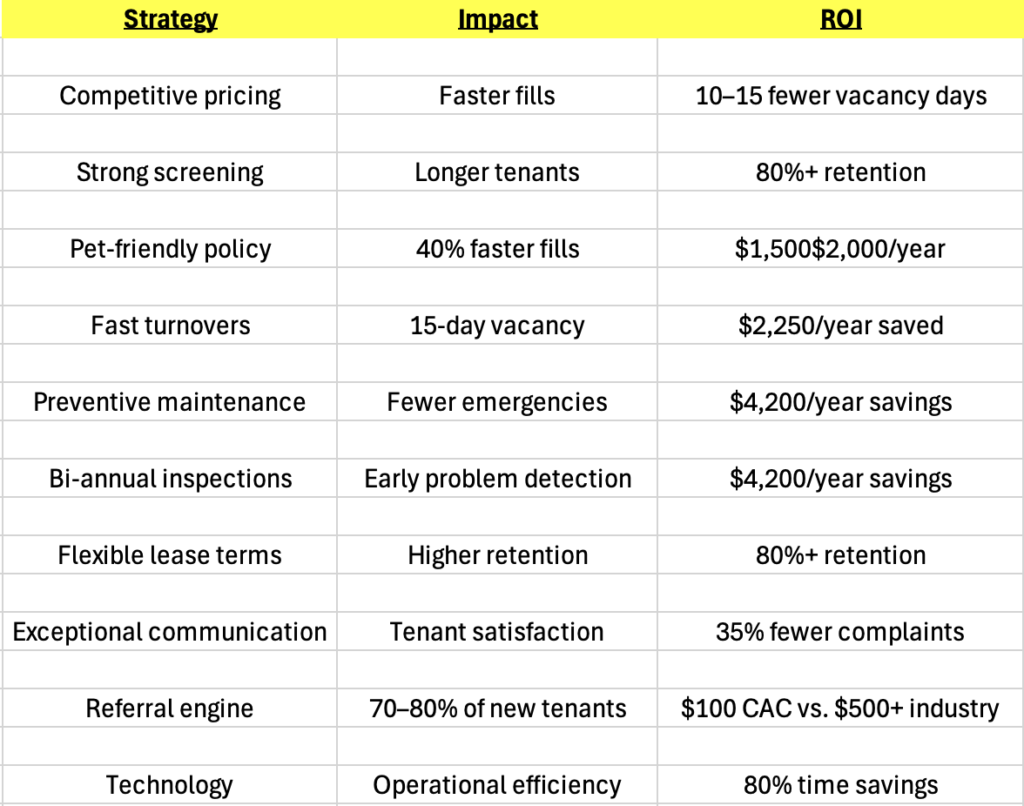
Combined annual benefit per property: $15,000–$25,000 in reduced vacancy, increased revenue, and operational savings.
Common Mistakes That Cause Vacancy
❌ Mistake #1: Overpricing
Hoping for $1,600/month when the market supports $1,400 only extends vacancy.
❌ Mistake #2: Poor Screening
Filling a unit fast with a problem tenant costs more than waiting for a quality tenant.
❌ Mistake #3: Ignoring Pet Owners
Excluding 67% of potential tenants because of pet policies is leaving money on the table.
❌ Mistake #4: Slow Turnovers
Every day a property sits empty is lost rent. Prioritize fast, professional turnovers.
❌ Mistake #5: Reactive Maintenance
Waiting for tenants to complain about problems drives them away. Be proactive. ❌ Mistake #6: Poor Communication
Tenants who feel ignored leave. Respond fast, communicate clearly, be transparent.
❌ Mistake #7: Inflexible Lease Terms
Long-term leases with penalties trap tenants and breed resentment. Flexibility builds loyalty.
✅ The Simply Live Approach:
Competitive pricing + strong screening + pet-friendly policy + fast turnovers + preventive maintenance + exceptional communication + flexible terms + technology = 15-day average vacancy and 80%+ retention.
Your Action Plan: 30 Days to Year-Round Occupancy
Week 1: – Run market comps on all your properties – Adjust pricing if needed – Review your current screening process
Week 2: – Implement or strengthen your pet policy – Create a turnover checklist – Set up professional photography for any vacant units
Week 3: – Schedule bi-annual inspections – Create a preventive maintenance calendar Set up automated communication (AppFolio, email templates)
Week 4: – Train yourself and any staff on the screening process – Implement response time standards (24 hours for inquiries, <24 hours for maintenance) – Set up a referral tracking system
Result: Within 30 days, you’ll have the foundation for year-round occupancy.
Final Thoughts: Occupancy is a System, Not Luck
After 19 years and 158+ properties, I can tell you with certainty: Properties that stay occupied year-round aren’t lucky—they’re systematic. They’re priced right. They’re filled with quality tenants. They’re maintained proactively. They’re managed with clear communication and flexible terms. And they’re supported by technology that enables efficiency.
If you’re struggling with vacancy, it’s not because the market is bad or tenants are unreliable. It’s because one or more of these systems is broken.
The good news? Every system can be fixed. And when you do, your vacancy drops from 45 days to 15 days. Your rent gets paid consistently. Your property stays in great condition. And your annual income increases by $10,000–$20,000 per property.
That’s not luck. That’s business.
If you’re a property owner in Michigan’s tri-county area ready to implement these systems, let’s talk. We offer a free 20-minute consultation to review your current situation and show you exactly how to keep your properties occupied year-round.
Ready to eliminate vacancy? Visit www.simplylive.com or give us a call. We manage 158+ properties with an average vacancy of just 15 days per year. We know what works —and we can help you implement it.
About Simply Live LLC Simply Live is a full-service property management company serving Lower Michigan’s tri-county area. With 158+ properties under management, a 4.9-star Google rating, and 80%+ client retention over 7 years, we specialize in systems that reduce vacancy, increase tenant retention, and maximize rental income. No hidden fees. No markups. Just honest property management that works.
Recent Comments